
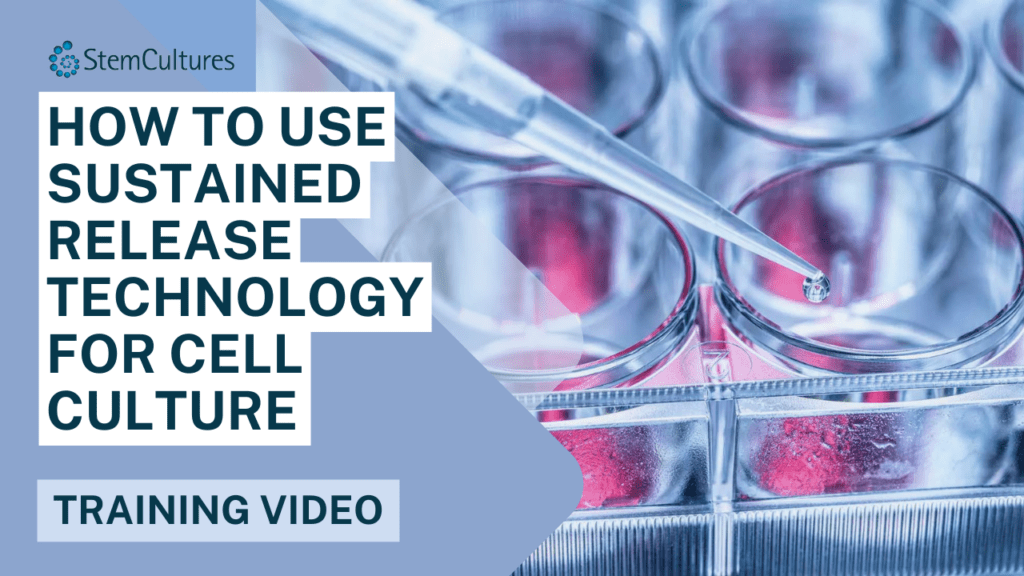
Alongside the recent launch of several new products, StemCultures launched a training video on sustained release technology. Focusing on both general cell culture techniques as well as StemCultures specific tools, Business Manager Krissy Roberts clearly and helpfully explains the background and science of these methods. She also goes in depth into the methods for each, offering tips and tricks to listeners.
General Cell Cultures
Starting off with a basic overview, the first three minutes of the training focus on laying the groundwork for cell culturing. This segment also includes definitions of terms from the cell culturing process and reviews the basic science behind cell culturing. Also shown is the standard feeding cycle for cells, including daily feeds due to small half-lives of the growth factors. This process is expensive and can easily lead to poor cellular output downstream from small variations or mistakes.
Cell Cultures with StemBeads and DISC Devices
The video then focuses on the use of StemBeads and DISC devices within cell cultures. The biodegradable StemBeads only need to be added three to four times per week. This is a significant change compared to a daily feeding schedule when it comes to time management. StemBeads have also been shown to improve the quality of cells thanks to maintaining the growth factor levels. Details on recommended concentration of StemBeads are product specific and included in the individual product sheets.
Similarly, the DISC devices can be added into cell cultures to significantly cut down on the time spent feeding and maintaining cultures. These biocompatible but non-degradable and inert hydrogels contain StemBeads. They sustain cultures for one to two weeks at a time and are available in FGF2, BDNF, and GDNF. The video narrates the process for adding and removing DISCs from culture wells. Additional instructional videos are found at the StemCultures website. We recommend all cell cultures, regardless of density, line, or type, be monitored and feeding schedules be adjusted accordingly.
Supporting Resources
Finally, the video concludes by reviewing the supporting documentation surrounding the StemCultures sustained release products. Thanks to many years of research and testing and collaboration with the NeuraCell CORE Facility, StemCultures has a significant wealth of data indicating the benefits of using StemBeads and DISC devices. Among the benefits are reductions in spontaneous differentiation, increased pluripotency, and greater downstream efficiency. More details on the benefits of sustained release technologies are found here. Additionally, many recent publications used StemCultures technology to further their work and advance their respective fields. Some of these papers are found on our website here, sorted by year.
StemCultures in 2024
Looking forward to the coming year, StemCultures is excited to continue supporting research across different fields through sustained release products. From tried and true StemBeads to the newest DISC devices, these products are making a significant impact on cell cultures. The StemCultures team will be heading to conferences throughout the year to highlight this as well, including ISSCR 2024 in Hamburg, Germany. Stay tuned for updates throughout the year, along with the new protein feature on StemCultures social media. It will be highlighting some of the common proteins that are used, starting with FGF2. StemCultures looks forward to continuing to bring new and exciting news to the public throughout the year via email, blog posts, and social media.
—
Note: Opinions and accounts expressed herein are those of the author(s) or interviewee(s). They may not reflect those of StemCultures, its officers, or directors.