
While there are multiple methods to achieve high quality cells, making sure the growth factors have a sustained release benefits a number of important qualities in cells growth. Time, funds, and effort are all directly impacted and using best-practices with sustained release can significantly benefit your lab. Below is a list and explanation of some of the benefits of maintaining a sustained release of your growth factors. Using efficient and reliable products, like StemBeads or DISC Devices from StemCultures, are some of the best ways to achieve sustained release and improve your culturing.
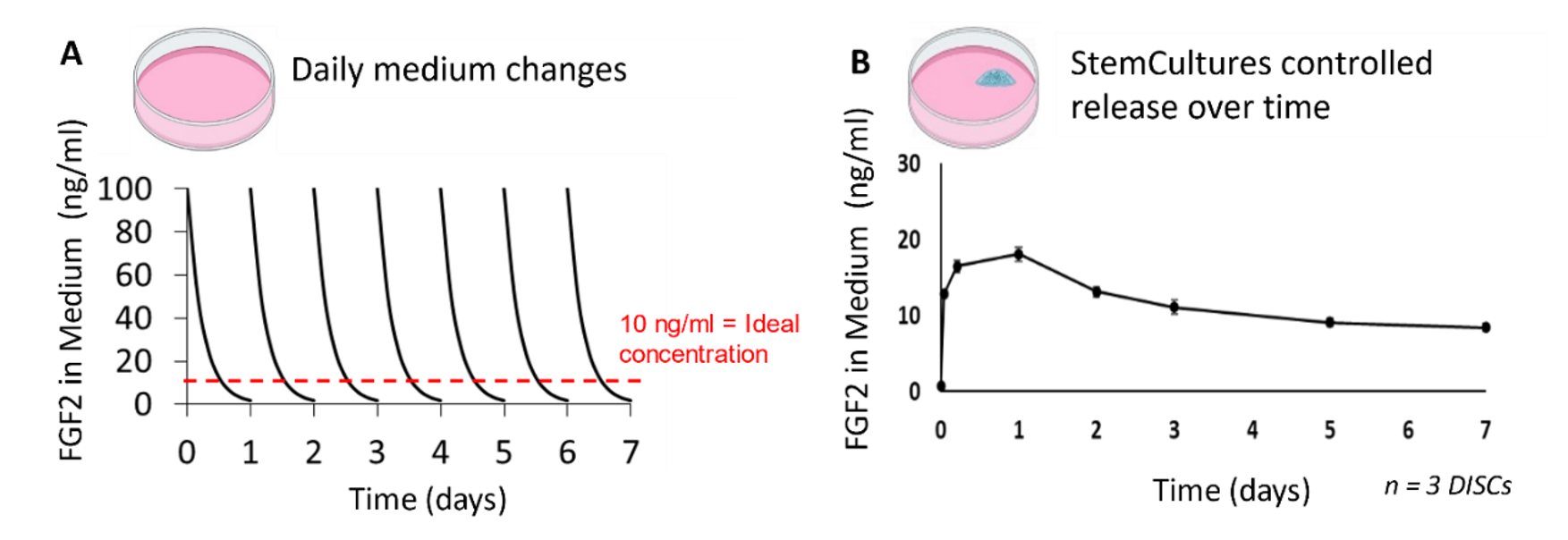
Figure A above demonstrates the current standard of daily medium changes. This method revolves around adding additional growth factor each day through medium changes. Maintaining any constant level of concentration, besides zero, is not feasible due to the short half life and rapid consumption of the growth factors. The figure also demonstrates the basic concept of a controlled release of growth factor from StemCultures DISC Devices product (Figure B). Already, some benefits are clear, but five major benefits have been identified and explained below when it comes to sustained release growth factor products. All of these benefits directly impact the time, funds, and effort that go into your cultures.
Benefits
Fewer Feeds
With sustained release technology, fewer feeds is an obvious and immediate benefit. The time and materials saved is a huge incentive for any researcher or lab technician. Going into the lab every day just for adding growth factors and performing medium changes can be tedious and a significant challenge for developing a healthy work life balance.
Beyond time, quality and cost are also impacted. Fewer feeds results in less material waste and error, which can significantly drive up costs. A handy resource focusing on the tips and tricks of a sustained release feeding schedule can be found here. It outlines the significant benefits in quality that can accompany a sustained-release feeding schedule. The better environment created by performing fewer feeds leads to an easier time down the road with further differentiation tasks. It also reduces the risk of a failed culture, which can double costs and stretch funding thin.
Increased Pluripotency
Increased pluripotency has been a proven benefit in sustained release cultures. Comparisons between cultures developed with daily feeds of soluble growth factor and cultures developed with sustained release products demonstrate significantly better pluripotency. The figure below compares these two methods via flow cytometry. It specifically analyzes two pluripotency markers, SSEA4 and Tra-1-60, in hPSCs grown with FGF2. The increased number of cells found in Q2, the region of cells displaying both sets of markers, indicates a higher success in the growth of the cells. A sustained release of growth factor also eliminated the secondary population of pluripotent cells found in Q4. These cells only stained positive for one pluripotency marker and were not successfully grown.
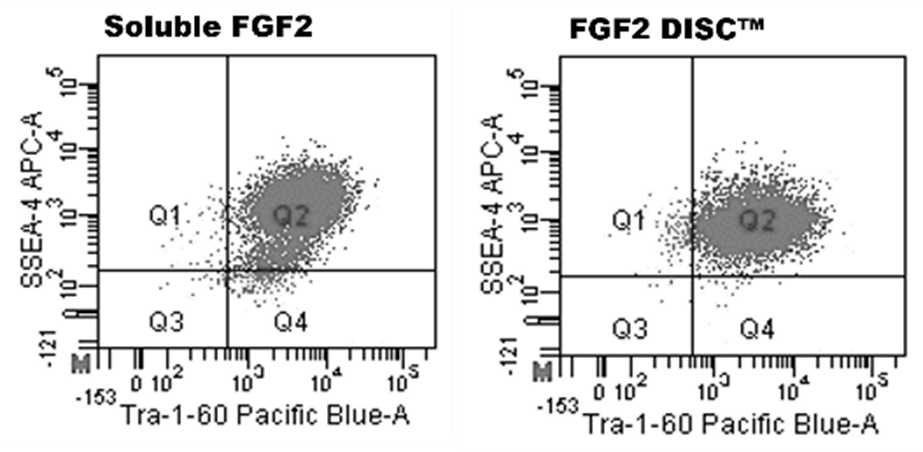
The increase in pluripotency is significant in saving time and funds. Screening cells for unwanted spontaneous differentiation is another tedious process that can be minimized. Reducing the amount of time spent screening cells enables labs to run more efficiently. It also reduces the number of cells needed overall due to the increased yield. Freeing up funds from being spent on cells benefit the lab overall and reduce funding pressures over a longer period.
Improved Differentiation
Increased pluripotency from cells grown with sustained release growth factors allows cells to be efficiently manipulated in downstream differentiations. From this, the evidence surrounding the improved differentiation of cells is exceedingly clear. Errant differentiation can significantly reduce the yield, once again impacting the time and funds spent on a single culture. The figure below illustrates this extremely well.
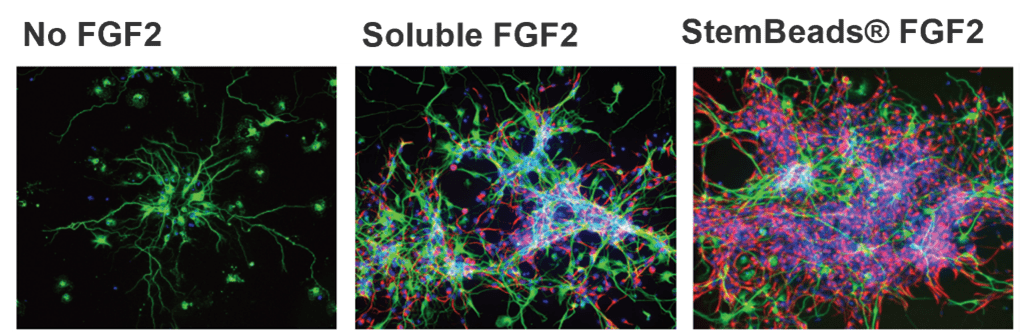
Mouse neural stem cells grown over the course of a week in three different environments are shown. They have been stained for Nestin+ and TUJ1+, which indicate progenitor cells and neuronal differentiation respectively. The culture in the FGF2 StemBeads environment clearly shows increased progenitor cells and decreased neuronal differentiation when compared with the culture grown with soluble FGF2 or no FGF2. This clear difference in yield demonstrates the benefits of sustained release in the improvement of differentiation.
Better Organoids
Organoid development is a newer area where sustained release growth factors have shown significant benefits. The graphic below mainly speaks for itself, but it is important to note that the biggest impact of sustained release on organoids comes from the high quality iPSCs. The highest quality iPSCs possible are needed to efficiently pattern and grow organoids. Sustained release allows these iPSCs to be grown and used.
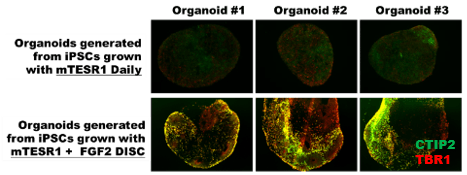
The significant visible difference between organoids generated from iPSCs grown with daily feeding and those grown with FGF2 DISCs when stained with CTIP2 and TBR1 show the success of developing organoids from iPSCs grown with the sustained release of growth factors. The better patterning and yield are significant considering the amount of effort and time it takes to generate organoids. iPSC lines that could not generate well patterned organoids now can do so, if they are maintained with sustained release technology. The impact is also significant, as better patterning will assist in testing and additional research.
Concentration
Consistency is key. Maintaining a consistent concentration of growth factor is extremely beneficial in the development of cultures. As demonstrated by the graphic below, a consistent level is not present when administering daily medium changes. A sustained release with a product like StemCultures DISC Devices enables a known and stable growth factor. Being able to more definitely know, and therefore control, the concentration helps to decrease the time and effort that goes into managing the culture.

Another benefit for sustained release is using a lower concentration of growth factor. Decreasing the concentration of growth factor does not negatively affect the culture. This is mainly due to the increased stability of growth factor. High concentration mediums (ex. 100 ng/mL) quickly decrease in concentration to below optimal levels. A controlled release device will maintain the ideal environment for the development of the culture even at significantly lower concentrations (ex. 10 ng/mL).
StemCultures
Trying to culture cells and develop organoids is already a difficult task. In order to reduce the additional trouble of designing and setting up a controlled release system, StemCultures has developed products that can be implemented rapidly to make the process easier. StemBeads and DISC Devices help achieve higher yields while cutting down the time, funds and energy it takes to achieve them. More information on these products is readily available on the StemCultures website and these products are available for sale as well.
—
Note: Opinions and accounts expressed herein are those of the author(s) or interviewee(s). They may not reflect those of StemCultures, its officers, or directors.