
StemCultures strives to assist and support their customers and, thanks to recent customer feedback, recently was able to answer some of the frequently asked questions about sustained release DISC devices and StemBeads® from the research and development team at NeuraCell. With their expert understanding of the ins and outs of how DISCs function, combined with their experience with StemCultures products, the NeuraCell team is equipped to answer users’ questions. Their assistance, as well as that of the Neural Stem Cell Institute and other customers, is invaluable in developing and improving StemCultures products.
About NeuraCell and the Research Team
NeuraCell is a CORE facility committed to engaging in contract research, production of high-quality cell lines, and other services. The group has over 20 years of experience working with various cell types including induced pluripotent stem cells, neural progenitor cells, and retinal pigment epithelial cells. The team is headed by Director Steve Lotz, who manages day-to-day operations and utilizes controlled-release technology on all cell lines. The team also includes Dr. Taylor Bertucci whose strong background in polymers science made her an asset to supporting StemCultures. She devotes most of her research to using iPSC-derived organoid models to study neurovascular interactions in Alzheimer’s disease. NeuraCell is a part of the Neural Stem Cell Institute (NSCI), the first independent stem cell research institute in the country.
DISC Devices Frequently Asked Questions
StemCultures had the opportunity to ask the NeuraCell team some of the questions brought to them by their customers. These ranged from questions about their experience with the Neural Stem Cell Institute to their work with StemBeads® and DISC devices. Below are excerpts from the interview, edited for clarity with additional information.
Can you give a brief overview of how the StemBeads® and DISC technology works?
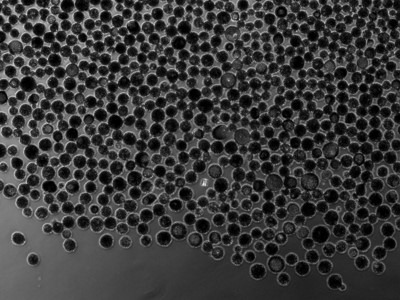
Mr. Steve Lotz (SL): The StemBeads® technology encapsulates selected proteins into controlled release microbeads. The beads, which will release a sustained concentration of protein, are then added to your cultures. The use of beads allows flexibility in released protein concentration. This enables the desired concentration to be tailored to the culture vessel size, such as 384 well plates to flasks.
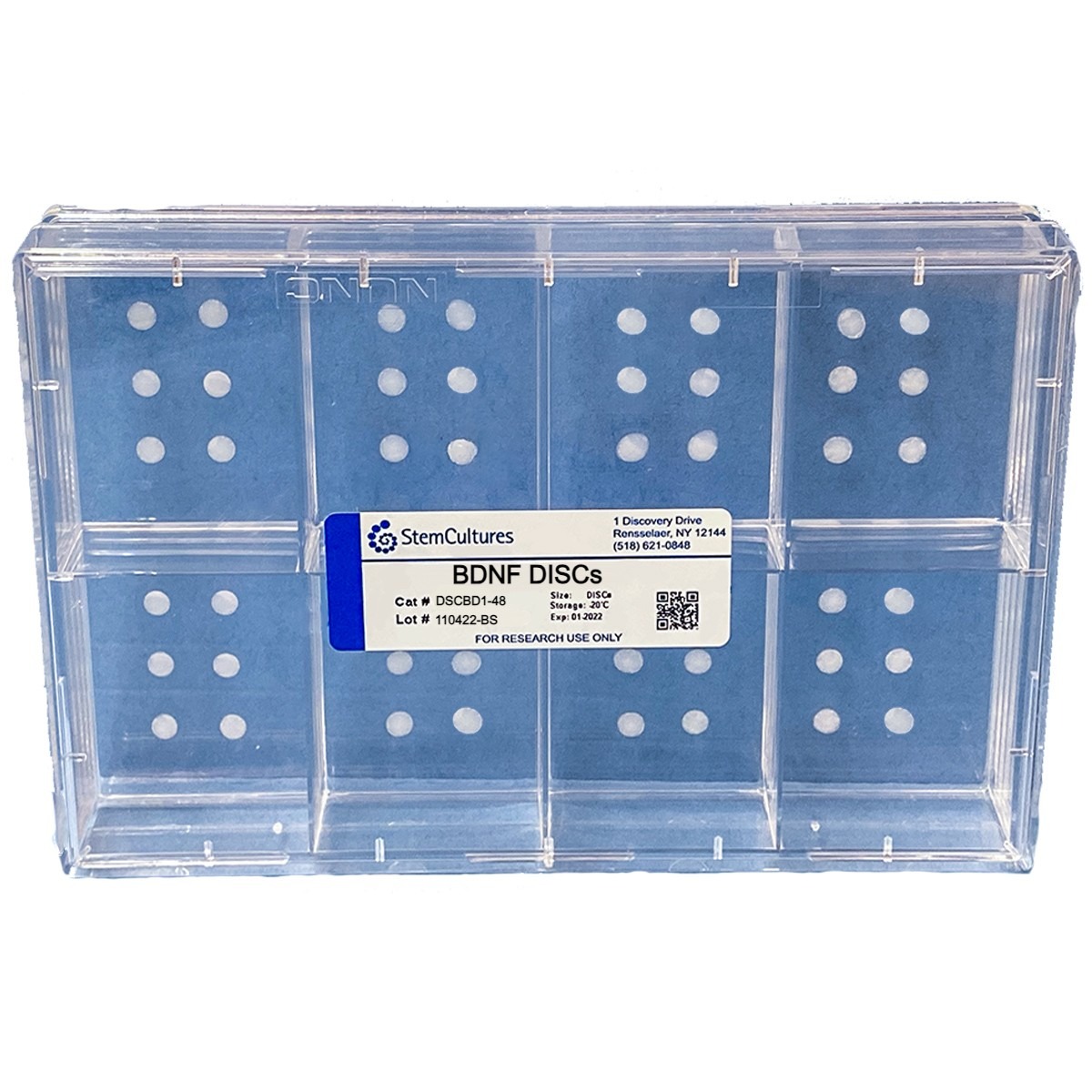
Dr. Taylor Bertucci (TB): DISCs are a platform technology in which controlled-release microbeads are packaged into a user-friend device, making it an easy addition into cell cultures. We often use this analogy: the DISC is a tea bag that holds all the loose tea, i.e. StemBeads®, together.
StemCultures currently offers FGF2 DISC devices, but aims to bring more options to market soon. These devices are based on the StemBeads® technology, which has additional options including GDNF, BDNF, and Activin A. An instructional video that may assist those working with DISCs in media can be found here. It shows how to change media with a DISC (1:54) and how to remove DISCs (2:49). For more information on the DISC product and their usage in research, read more on the StemCultures website or feel free to contact us.
In what ways has your research and lab benefited from the DISC technology?
SL: The use of DISCs has allowed me to increase the number of lines I can carry by 4-5-fold while keeping the cells in a more pluripotent state. This in turn allows my differentiation to be more efficient and reproducible. Also, the use of DISCs saves on time, allowing the Core to take on more or bigger projects.
TB: We have been able to generate organoids successfully from more lines than we were able to previously. This has made it easier to do additional repetitions and larger studies. We also no longer have weekly weekend feeds.
One major benefit of sustained-release growth factors is the improved success of organoid development. There are many more benefits depending on the usage, such as improved differentiation and increased pluripotency. Additionally, thanks to sustained release technology, weekend and holiday feeds are left in the past. Cultures can go for days without additional feeds, freeing up time for other tasks or for the enjoyment of weekends and breaks.
When would you prefer normal StemBeads® over DISC devices and vice versa?
TB: StemBeads® are helpful to use when you first adapt sustained release protocols. The beads will allow you to test different concentrations and titer down to the level needed for optimal sustained release. DISCs are more for routine use in cultures where the sustained release concentration is established. The ideal concentration is already determined and can be easily and steadily released from the DISCs.
SL: I prefer to use DISCs in my iPSC cultures. When culturing with DISCs, I can fully remove the DISC. Unlike StemBeads®, where one must wash away the beads, potentially leaving some behind. This can greatly affect our differentiations. For high thruput assays, such as drug screenings that use 96 or 384 well plates, I use StemBeads®.
To accommodate and support researchers, StemCultures offers a number of different StemBeads®. Customers can also contact StemCultures to order custom StemBeads® for their specific research.
What are the questions you commonly get from users and how do you answer those questions?
TB: We often get questions about what concentration, or level, of sustained-release you need to add to your media. We have found the concentration required of a sustained-release growth factor is significantly less than what you might be used to adding for a soluble growth factor. For example, in hPSC culture, most media will include 100 ng/mL of soluble FGF2, which degrades quickly and therefore is replenished daily. With a stable level of FGF2, the cells require only 10 ng/mL of FGF2 from a DISC. For new culture applications, we recommend trying a five to ten-fold lower concentration from sustain-release growth factors and comparing it to the soluble growth factor results.
SL: I often get the question “Can I use the DISCs or beads in my media?”. We have tested the DISCs and StemBeads® in multiple commercial iPSC mediums, and they work just fine. We have also tested them on multiple cell types such as NPCs, fibroblasts, and cortical cells and in all cases the cells out-performed normal culture conditions.
How would you recommend people use the DISC devices if they need them to float?
TB: Some cell types are more prone to detaching off cell culture plates, such as neurons. For those cultures, we recommend adding the DISCs in a transwell. The DISC will provide approximately the same sustained-release level throughout the transwell membrane. For example, for a culture of 1 milliliter we would add 750 microliters and then 250 microliters plus a DISC into the transwell.
DISC devices are widely applicable to different environments and uses. As Dr. Bertucci described, use of DISCs in a transwell is possible and can help with neuron culture development. Additional applications for DISC devices and StemBeads® are the development of organoids, proliferation and differentiation of iPSCs, and growth and development of hPSC cultures.
What is one tip that you can give users to better help their experience?
SL: Don’t become complacent. You don’t have to feed your cells every day, but you still should look at them under a microscope as often as possible.
The Future of Controlled-Release Technology
StemCultures plans to continue to innovate and develop DISC and StemBeads® offerings for a greater number of growth factors. One major project is the development of DISC analogs for all remaining StemBeads®. Beta testing of these products is currently underway, and any researchers and labs interested in being a part of the development are invited to reach out with any questions. Additionally, developing new sustained-release growth factors is at the forefront of StemCultures research and development. New products in StemBeads® format are in development and are planned for public release soon. Please reach out if you have any questions and are interested in helping bring these products to the public.
StemCultures aims to continue to support their customers and is happy to answer any additional questions about sustained release DISC devices not covered above. Please contact us via our website or email. Additional information can also be found throughout the StemCultures website, including general culturing tips and tricks, DISC devices efficacy and usage, and DISC product listings.
—
Note: Opinions and accounts expressed herein are those of the author(s) or interviewee(s). They may not reflect those of StemCultures, its officers, or directors.